
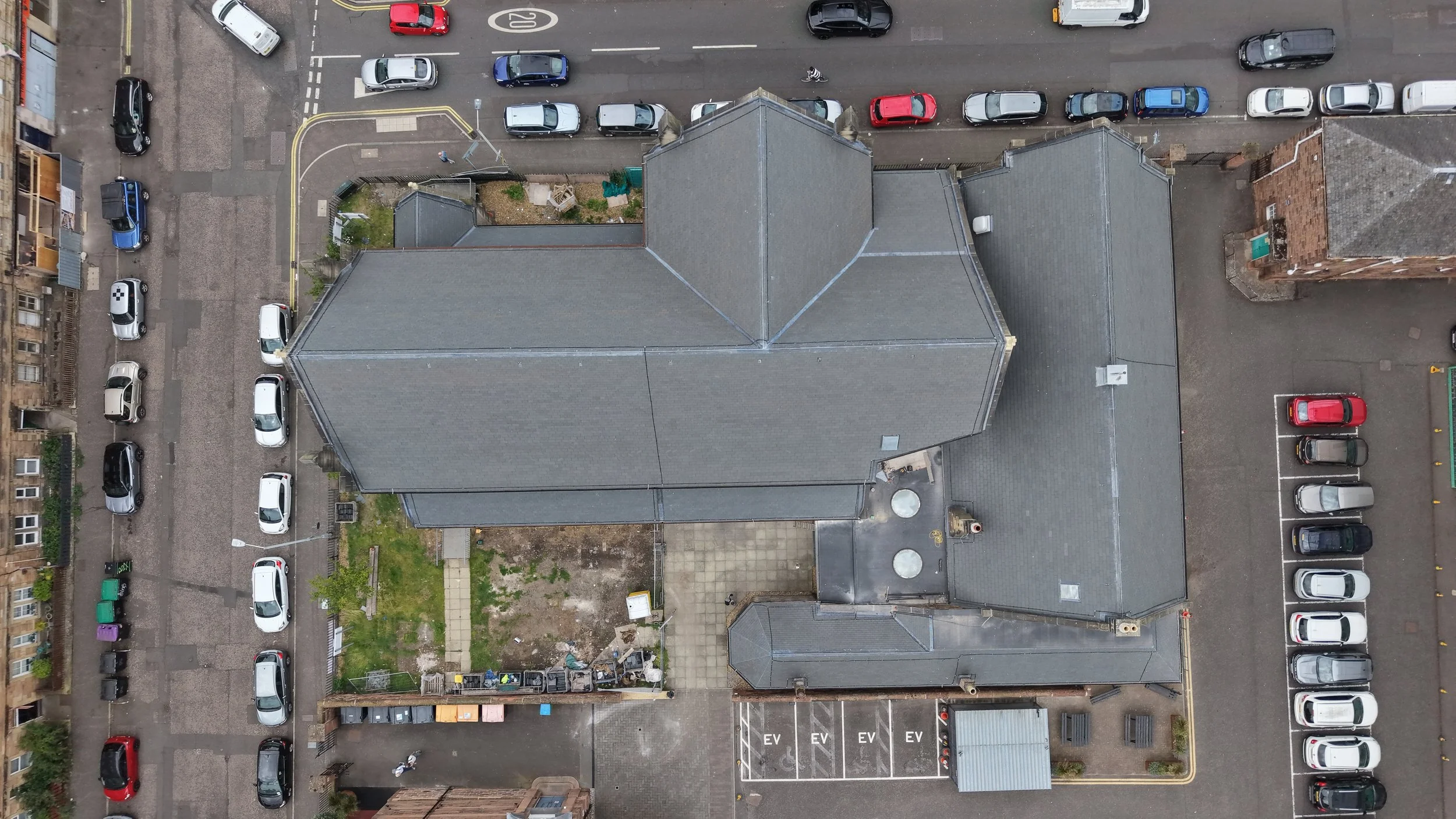
Norton Park: Before and After
Conservation in Practice
One of the things I enjoy most about working with historic buildings is that, however much investigation you carry out beforehand, they can still surprise you once work begins.
That was certainly the case at Norton Park Church in Edinburgh, where we have recently completed a major programme of roof repairs.
The Category B listed former church has a particularly complex roof, made up of 19 separate slopes, some reaching pitches of 55 degrees. When we first became involved, hundreds of slates had slipped, previous repairs were beginning to fail and the height and steepness of the roof made ongoing maintenance increasingly difficult. At one stage, a temporary ‘snow board’ had even been installed to catch falling slates.
Understanding what we had
One of the most interesting aspects of the project was the original slate.
The roof was covered in small Westmorland green slates, traditionally known as ‘green peggies’. We believed them to be at least 125 years old and, remarkably, examples we inspected before work began still produced a solid ‘ring’ when struck with a hammer, suggesting there was life left in the stone.
Naturally, our ambition was to retain as much of that historic material as we reasonably could.
We spent a considerable amount of time assessing the size and condition of the slate, looking at how it could be redressed and considering how traditional Scottish double-nailing could allow us to reuse some of the smaller pieces. Based on what we could establish before the roof was stripped, we hoped that around 14.5% of the original slate might be suitable for reuse.
Once work began, however, the building told us something different.
With the roof stripped and the slates individually assessed, it became clear that none were suitable for reuse on Norton Park.
For me, that is a good example of conservation in practice. You investigate, survey and plan as thoroughly as possible, but you also have to be prepared to respond to what you find.
Finding the right replacement
Once we knew the original slate could not be reused, choosing the right replacement became even more significant.
We specified Burlington blue/grey slate because its thickness, texture, irregularity and weathering characteristics make it a sympathetic match for Westmorland green. There was also good precedent for the choice, with Historic Environment Scotland having selected Burlington blue/grey for the re-slating of Stirling Castle because of its compatibility with historic grey-green slate.
It made sense practically too. Burlington blue/grey has evidence of a lifespan exceeding 200 years and was approximately one-third of the cost of replacement Westmorland green. It could also be supplied within weeks, whereas obtaining the approximately 60 tonnes of Westmorland green slate required could potentially have taken years.
More than a slate roof
Although the transformation of the slate roof is what you immediately notice in the before-and-after footage, the project involved much more.
We also had to consider extensive leadwork, traditional fireclay ridge tiles, three chimneys, two flat roof areas, cast-iron gutters and downpipes, stonework and the building’s lightning conductor system.
All of these elements have to work together. What can look like a relatively straightforward roof repair from ground level is, in reality, a series of decisions about materials, detailing, water management and how the building will perform for decades to come.
The finished roof is immensely satisfying to see, but for me the more interesting story is the process behind it. Understanding what is there, trying to retain what you can, accepting when that is no longer possible and finding an appropriate solution for the future.
Norton Park is not being repaired simply to preserve an old building. It is home to a charity that supports other charities and community organisations, and these works are part of plans to make better use of the former church in the future.
That is ultimately what conservation should allow us to do: look after the character and history of our buildings while helping them remain useful for the people who need them.